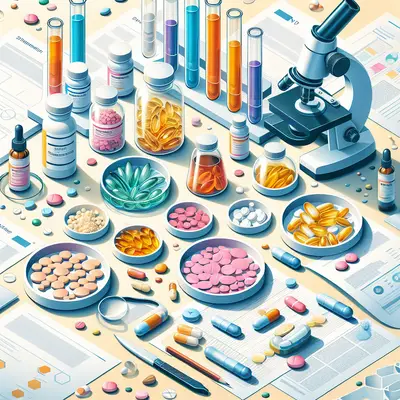
Most of us first meet a supplement as a glossy bottle on a shelf or a sponsored post in our feed—not as a line in a scientific journal. But behind every ingredient claim and “clinically studied” badge, there’s (ideally) a research trail. Understanding how that research is designed, interpreted, and translated into products can help you move from “this sounds promising” to “this is worth my money and attention.”
This guide walks through five evidence-based ideas about how supplement research actually works—so you can recognize stronger evidence, spot weak spots, and ask better questions before you buy.
1. Not All “Evidence” Starts in Humans (and That Matters)
A lot of exciting supplement headlines begin with cell or animal studies. These early-stage experiments are valuable, but they don’t tell you what will happen in real people living real lives.
In vitro studies (in test tubes or petri dishes) explore mechanisms: how a compound affects cells, enzymes, or signaling pathways under tightly controlled conditions. Animal studies extend this by looking at a whole organism—often using doses and delivery methods that don’t match typical human use. Both can generate hypotheses, but they’re not proof that a supplement will improve sleep, energy, or joint comfort for you.
Human data is what really moves the needle. Even then, design matters: Was there a control group? Was it randomized? Were participants and investigators blinded to what was given? How big was the study, and how long did it last? When you see a claim, mentally trace it back: Is this supported by human trials, or mostly preclinical work? If it’s early-stage science only, treat it as “interesting but unproven,” not as a green light for strong health promises.
2. The Strongest Supplement Claims Come From Well-Designed RCTs
Randomized controlled trials (RCTs) are the gold standard for testing whether a supplement truly does what it claims. In an RCT, participants are randomly assigned to receive the supplement or a comparison (placebo or standard treatment), and researchers track outcomes over time.
Good RCTs share a few key features:
- Randomization reduces bias by distributing known and unknown factors (like diet, sleep, or stress) evenly between groups.
- Blinding (ideally double-blind) helps prevent expectations from influencing results—on both the participant and researcher side.
- Placebo control allows you to distinguish a real effect from changes that come simply from believing you’re doing something beneficial.
- Predefined outcomes (registered before the study starts) reduce “cherry-picking” only the most favorable results after the fact.
Supplements with multiple independent RCTs—especially when conducted by different research groups, in different populations, and with consistent protocols—are more likely to deliver the effects they claim. When you see “clinically studied,” try to find at least one actual RCT and look for details: population (healthy vs. diseased), dose, form (e.g., magnesium citrate vs. oxide), and duration.
3. Dose, Form, and Baseline Status Change the Story
Even when an ingredient has solid research, the details can dramatically shape outcomes.
- Dose: Many trials use doses higher than what appears in common supplements, or vice versa. If a study used 2,000 mg of an ingredient and your capsule has 250 mg, you shouldn’t expect equivalent results.
- Formulation: Different chemical forms can have very different absorption and tolerability profiles (for example, magnesium glycinate vs. oxide, or cyanocobalamin vs. methylcobalamin for B12). Studies usually specify the exact form, which may or may not match what’s in a product.
- Baseline nutrient status: Deficient or low-status individuals often see larger benefits than people already replete. A vitamin D trial in deficient adults is not directly comparable to taking vitamin D when your levels are already optimal.
- Population characteristics: Age, sex, health conditions, medications, and lifestyle habits (diet, exercise, alcohol) all influence responses. An ingredient that helps a specific patient group might offer little or no benefit in the general population—or vice versa.
When reading about supplement research, look beyond the headline finding and ask: “For whom, in what form, at what dose, and starting from what baseline?” This helps you gauge how closely the study population matches your own situation and whether a product’s label is anchored to the evidence or only loosely inspired by it.
4. Meta-Analyses and Systematic Reviews Help You See the Bigger Picture
Single studies can be misleading—especially if they’re small, short, or industry-funded. That’s where systematic reviews and meta-analyses come in. These research methods synthesize results from multiple trials to estimate an overall effect and explore why studies might disagree.
A systematic review uses predefined criteria to search, select, and evaluate all available studies on a question (for example, “Does omega-3 supplementation lower cardiovascular risk?”). A meta-analysis adds a statistical layer, pooling data to calculate an overall effect size and examining factors like dose, population, and study quality.
These syntheses can reveal patterns that individual studies miss:
- Whether positive findings cluster in small or lower-quality trials
- If benefits appear only in specific subgroups (e.g., people with high inflammation or low baseline intake)
- Whether higher doses offer more benefit—or hit a plateau
- How consistent results are across research teams and regions
When possible, anchor your opinion of a supplement to systematic reviews or meta-analyses rather than a single high-profile trial. If those broader analyses report only modest benefits, inconsistent results, or significant methodologic limitations, it’s a signal to keep expectations realistic—even if marketing copy sounds emphatic.
5. Funding, Regulation, and Publication Bias Shape What You See
Supplement science doesn’t happen in a vacuum. Three structural forces heavily influence what gets studied, what gets published, and what ends up in front of consumers.
1. Funding sources:
Supplement trials are often funded by manufacturers or industry groups. That isn’t automatically a red flag—many high-quality studies are industry-supported—but it does increase the importance of strong methods, transparent reporting, and independent replication. Look for disclosures in the paper’s “Funding” and “Conflicts of Interest” sections.
2. Regulatory environment:
In many countries, including the United States, supplements are regulated more like foods than drugs. Manufacturers do not need to prove efficacy before bringing a product to market, and pre-market safety requirements are limited. That regulatory reality means the research bar can vary widely from ingredient to ingredient; some have decades of rigorous study, others rely on preliminary or traditional-use evidence only.
3. Publication and reporting bias:
Positive results are more likely to be written up and published than null or negative ones. This means the literature can overrepresent “success stories” and underrepresent trials where a supplement had no effect or caused side effects. Trial registries and pre-registration help, but they’re not universal.
For health-conscious readers, this context doesn’t mean “ignore all supplement research.” It means keep a calibrated skepticism: prefer products anchored in multiple, well-designed human trials; look for ingredients that have been independently replicated; and remember that absence of evidence is not the same as evidence of benefit.
Conclusion
Understanding how supplement research is designed, funded, and interpreted gives you more than trivia—it gives you leverage. Instead of relying on marketing language or single eye-catching studies, you can ask targeted questions: Is there human data? Are there randomized, controlled trials? What dose and form were tested? How does a product’s formula compare to the research, and do systematic reviews line up with the claims?
This kind of literacy doesn’t require a PhD. It just asks for curiosity about methods, not just outcomes—and a willingness to look for the bigger picture before you add something new to your daily routine. The more you align your choices with the strongest available evidence, the more likely your supplement shelf will reflect what’s genuinely useful, not just what’s currently trending.
Sources
- [National Institutes of Health Office of Dietary Supplements](https://ods.od.nih.gov/) - Fact sheets and research summaries on vitamins, minerals, and other dietary supplements, including discussions of evidence quality
- [U.S. Food and Drug Administration: Dietary Supplements](https://www.fda.gov/food/dietary-supplements) - Overview of how supplements are regulated in the U.S., including safety, labeling, and enforcement actions
- [Cochrane Library](https://www.cochranelibrary.com/) - Database of systematic reviews and meta-analyses on health interventions, including many supplement-related topics
- [Harvard T.H. Chan School of Public Health – Vitamins and Minerals](https://www.hsph.harvard.edu/nutritionsource/vitamins/) - Evidence-based guidance on micronutrients, supplement use, and interpretation of research
- [National Library of Medicine: ClinicalTrials.gov](https://clinicaltrials.gov/) - Registry of clinical studies where you can search for ongoing and completed trials on specific supplements and ingredients
Key Takeaway
The most important thing to remember from this article is that this information can change how you think about Research.