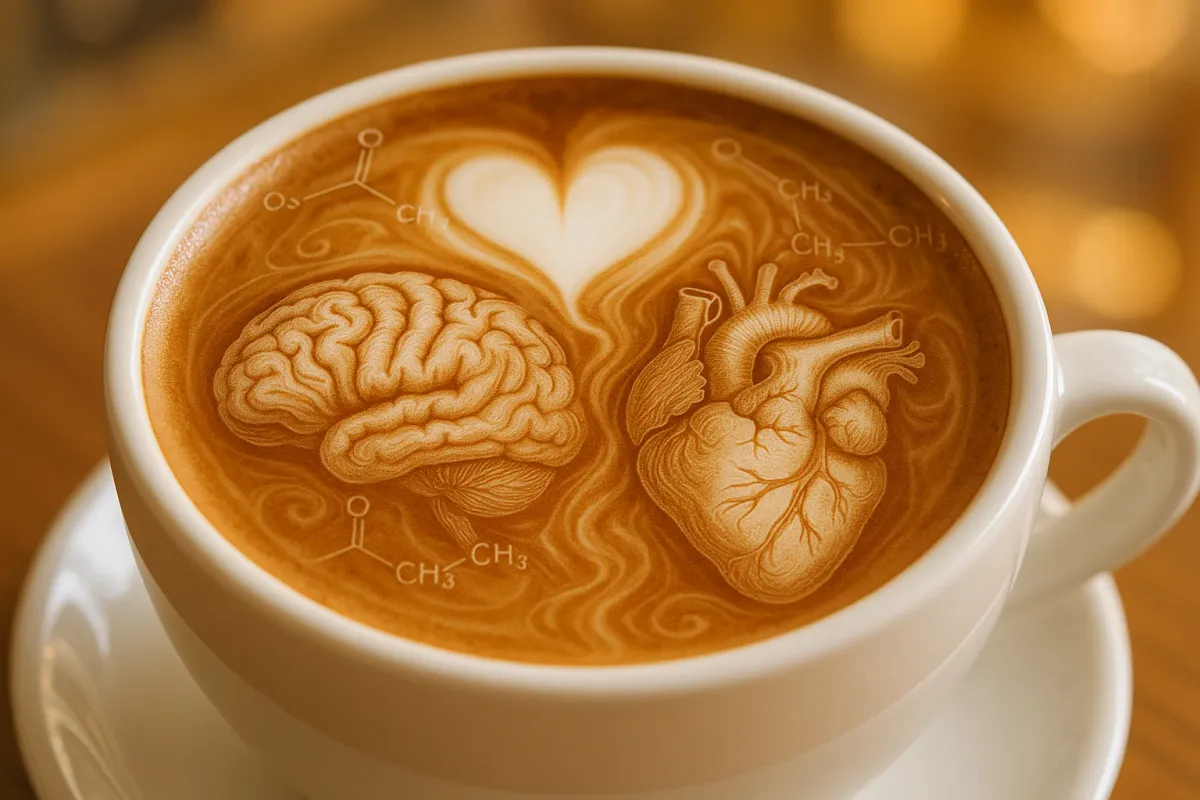
Scrolling through “accidental coffee art” posts is harmless fun—but what’s inside that mug matters more than the pattern on top. As social feeds fill with latte swans and espresso galaxies, caffeine has quietly become one of the most widely consumed psychoactive substances on the planet. That makes your daily cup not just an aesthetic moment, but a legitimate nutrition decision.
If you’re health‑conscious, you don’t need to give up coffee or tea. You do need to understand how caffeine actually works in your body, how much is safe, and how add‑ons like sugar, creamers, and “energy” ingredients change the picture. Here’s what current research says, in plain language.
1. Your Caffeine “Buzz” Is Really a Sleep‑Blocker, Not an Energy Source
Caffeine doesn’t create energy; it blocks fatigue signals. It works primarily by antagonizing adenosine receptors in the brain—adenosine is a molecule that builds up during the day and makes you feel sleepy. When caffeine blocks those receptors, you feel more alert even though your underlying “sleep pressure” is still there.
That’s why a strong coffee can temporarily mask exhaustion but can’t replace lost sleep. Large randomized trials show caffeine improves reaction time, vigilance, and perceived energy in the short term, especially in sleep‑deprived people. But the cost can be delayed or fragmented sleep later that night, setting up a cycle of “tired → caffeine → short sleep → more caffeine.” If you rely on coffee just to feel baseline functional, it’s usually a sign of chronic sleep debt, not a caffeine deficiency.
Practical takeaway:
Use caffeine to enhance performance when you’re generally well‑rested, not as a daily substitute for sleep. If you “need” it to feel normal, focus first on your sleep schedule, light exposure, and stress management.
Key evidence: Fredholm et al., “Actions of Caffeine in the Brain with Special Reference to Factors That Contribute to Its Widespread Use,” Pharmacological Reviews, 1999; McLellan et al., “Caffeine as a Psychomotor Stimulant,” Neuroscience & Biobehavioral Reviews, 2016.
2. There Is a Safe Zone for Most Adults—And It’s Lower Than Many Energy Drinks Provide
Regulators are remarkably consistent about where they draw the line. The U.S. FDA, Health Canada, and the European Food Safety Authority all converge around up to 400 mg of caffeine per day as a level that appears safe for most healthy adults. That’s roughly:
- 3–4 small (8 oz / ~240 mL) brewed coffees, or
- 7–8 shots of espresso, or
- 4–5 cups of strong black tea
But it’s easy to overshoot without realizing it. Some large café drinks can contain 250–350 mg in a single cup. Many energy drinks supply 150–300 mg per can, and “energy shots” may pack 200 mg or more in a few gulps. Pre‑workout powders often add another 150–350 mg per scoop, occasionally more.
Individual response varies widely due to genetics, medications, and health status. Variants in the CYP1A2 gene, for example, influence how quickly you metabolize caffeine. Slow metabolizers may experience stronger, longer‑lasting effects—and potentially higher cardiovascular risk at high intakes—than fast metabolizers.
Practical takeaway:
Total your daily caffeine from all sources (coffee, tea, soda, energy drinks, pre‑workouts, fat burners, caffeine tablets, even dark chocolate). If you’re regularly above 400 mg, or you notice palpitations, jitteriness, or anxiety, dial it back and spread intake over the day rather than loading it all at once.
Key evidence: EFSA Panel on Dietetic Products, “Scientific Opinion on the Safety of Caffeine,” EFSA Journal, 2015; Palatini et al., “Interaction Between CYP1A2 Polymorphism and Caffeine Intake on the Risk of Hypertension,” Journal of Hypertension, 2009.
3. Timing Matters More Than You Think—for Sleep, Hormones, and Performance
Caffeine has a half‑life of roughly 3–7 hours in most adults. That means half of what you consume at 3 p.m. may still be in your system at 9–10 p.m.; a quarter can remain close to midnight. Sleep researchers increasingly recommend a “caffeine curfew” of 6–8 hours before bedtime for people with insomnia, light sleep, or early awakening.
Morning coffee timing also interacts with cortisol, your natural “wake‑up” hormone. Cortisol peaks in the first 30–45 minutes after you get out of bed. Some emerging work suggests that waiting 60–90 minutes after waking before your first coffee may support a more stable energy curve by letting your circadian system do its job before adding a stimulant.
On the flip side, strategic timing can boost exercise performance. Dozens of trials show that 3–6 mg of caffeine per kg of body weight (about 200–400 mg for many adults) taken 30–60 minutes before exercise can improve endurance, perception of effort, and sometimes strength or sprint performance.
Practical takeaway:
- If sleep is a struggle, set a “last caffeine” time 6–8 hours before bed.
- Consider delaying your first coffee by an hour in the morning.
- For workouts, reserve moderate caffeine doses for days when performance truly matters, rather than every single session.
Key evidence: Clark & Landolt, “Coffee, Caffeine, and Sleep,” Sleep Medicine Reviews, 2017; Grgic et al., “International Society of Sports Nutrition Position Stand: Caffeine and Exercise Performance,” JISSN, 2021.
4. What You Add to Your Coffee Often Matters More Than the Coffee Itself
The “accidental coffee art” you see online is usually made with steamed milk—and what’s in that cup can shift it from a low‑calorie beverage to a substantial dessert. Black coffee or plain tea contain only a few calories. Additions change the nutrition profile quickly:
- Sugar and syrups: Many flavored lattes and seasonal drinks contain 30–60 g of sugar—more than a typical can of soda. High added‑sugar intake is linked to increased risk of type 2 diabetes, fatty liver, and cardiovascular disease.
- Cream and flavored creamers: Cream is energy‑dense; flavored creamers can combine saturated fat with added sugars and emulsifiers. Used liberally several times per day, they can meaningfully increase daily calorie intake.
- “Healthy” add‑ins (MCT oil, butter, collagen): These can have specific use cases but are not magic. Bulletproof‑style coffees are high in calories and saturated fat, which might be acceptable in a planned ketogenic diet but counterproductive for someone trying to manage weight or LDL cholesterol. Collagen adds some protein but doesn’t offset large amounts of sugar or fat.
The health benefits often attributed to coffee—reduced risk of type 2 diabetes, Parkinson’s disease, and certain liver conditions—come primarily from coffee itself (caffeine plus polyphenols like chlorogenic acids), not from sweeteners or creamers layered on top.
Practical takeaway:
- Default to unsweetened or lightly sweetened coffee/tea.
- Treat syrup‑heavy, whipped‑cream‑topped drinks as occasional desserts, not daily “fuel.”
- If you like cream, measure it once to see how much you’re actually pouring; many people underestimate.
Key evidence: Dhingra et al., “Fructose, Sugar, and Sugar‑Sweetened Beverages and Cardiometabolic Risk,” Journal of the American College of Cardiology, 2014; Poole et al., “Coffee Consumption and Health: Umbrella Review of Meta‑Analyses,” BMJ, 2017.
5. Caffeine Can Be Part of a Healthy Diet—If You Respect Your Personal Tolerance
The same dose of caffeine that sharpens one person’s focus can trigger anxiety or palpitations in another. Beyond genetics, factors that shift your personal tolerance include:
- Body size and age: Smaller individuals and older adults often feel stronger effects at lower doses.
- Medications: Some antibiotics, antidepressants, and oral contraceptives slow caffeine metabolism, effectively increasing its potency and half‑life.
- Pregnancy and breastfeeding: Major guidelines generally recommend ≤200 mg/day during pregnancy because caffeine crosses the placenta and is metabolized more slowly.
- Anxiety disorders and heart conditions: Even moderate caffeine can amplify symptoms in susceptible people.
At the same time, large observational studies consistently find that moderate coffee consumption (about 2–4 cups per day) is associated with lower risk of all‑cause mortality and several chronic diseases. While these studies can’t prove cause and effect, they suggest that for many people, moderate coffee intake within a balanced diet is perfectly compatible with long‑term health.
Practical takeaway:
Your best guide is a mix of evidence and self‑observation. Watch for red flags—racing heart, tremor, GI distress, increased anxiety, or sleep disruption. If you notice them, reduce dose, shift timing earlier in the day, or consider decaf. Decaffeinated coffee still contains many beneficial polyphenols with only a fraction of the caffeine.
Key evidence: Poole et al., BMJ, 2017; Grosso et al., “Coffee, Caffeine, and Health Outcomes,” Annual Review of Nutrition, 2017; ACOG Committee Opinion No. 462 on Moderate Caffeine Consumption During Pregnancy.
Conclusion
The next time a swirl of foam in your mug tempts you to snap a photo, remember that what can’t be seen in the picture—the caffeine dose, the sugar content, the timing—is what truly shapes your health.
You don’t need to fear caffeine, and you don’t need to quit your morning ritual. Focus instead on how much you consume, when you drink it, what you add, and how your body responds. Used thoughtfully, caffeine can be a useful tool for alertness and performance. Used mindlessly, it can quietly undermine sleep, stress levels, and long‑term health.
At Eleven Suplements, we encourage you to treat your coffee the same way you’d treat any supplement: understand the science, know your dose, and make it work for you—not against you.
Key Takeaway
The most important thing to remember from this article is that this information can change how you think about Nutrition.